Trusted Care for Your Child Starts Here!
-
Name :
Dr. Neha Agrawal
-
Specialization :
Pediatrician & Neonatologist
-
Experience :
12+ Years in Child Healthcare
-
Location :
Noida / Ghaziabad
Jaundice in Newborns: Causes, Signs & When to Worry | Best Pediatrician in Noida
Introduction
Bringing a newborn home is one of the most joyful moments of a parent's life. But within the first few days, many parents notice their baby's skin or eyes turning yellowish — a condition known as newborn jaundice or neonatal jaundice. While it is extremely common and often harmless, jaundice in newborns should never be ignored. If left untreated, severe jaundice can lead to serious complications affecting the brain and nervous system.
As a parent, understanding the causes, signs, and warning signals of newborn jaundice can help you take timely action and protect your baby's health. If you are looking for the best pediatrician in Noida for your newborn's care, this guide will help you understand everything you need to know.
What Is Newborn Jaundice?
Newborn jaundice is a condition where a baby's skin, eyes, and mucous membranes turn yellow due to a high level of bilirubin in the blood. Bilirubin is a yellow pigment produced when red blood cells break down. In adults and older children, the liver processes and eliminates bilirubin efficiently. However, in newborns, the liver is still immature and may not be able to process bilirubin fast enough, causing it to build up in the body.
Neonatal jaundice affects approximately 60% of full-term newborns and up to 80% of premature babies in the first week of life. In most cases, it is physiological (natural and self-resolving), but in some cases, it may indicate an underlying medical condition that requires prompt treatment.
Types of Newborn Jaundice
1. Physiological Jaundice
The most common type. It typically appears on the 2nd or 3rd day after birth and resolves on its own within 1–2 weeks. It is caused by the normal breakdown of fetal red blood cells and the newborn liver's temporary inability to clear bilirubin quickly.
2. Breastfeeding Jaundice
Occurs in the first week of life when a baby is not getting enough breast milk, leading to dehydration and reduced bilirubin elimination. Frequent feeding — at least 8–12 times per day — can help resolve this type.
3. Breast Milk Jaundice
A different condition from breastfeeding jaundice. Certain substances in breast milk can slow down bilirubin processing in the liver. It appears after the first week and may last 3–12 weeks but is generally harmless.
4. Pathological Jaundice
This is the serious type. It appears within the first 24 hours of birth and is caused by underlying medical conditions such as blood group incompatibility (Rh or ABO), infections, enzyme deficiencies (like G6PD deficiency), or liver disease. Pathological jaundice requires immediate medical attention.
Common Causes of Jaundice in Newborns
- Immature liver function — The most common reason in healthy newborns
- Blood group incompatibility — When mother's and baby's blood types differ (Rh incompatibility, ABO incompatibility)
- Premature birth — Preterm babies have even less mature livers
- Bruising during birth — Causes more red blood cells to break down
- Infection — Bacterial or viral infections affecting bilirubin processing
- G6PD deficiency — A genetic enzyme disorder common in certain populations
- Polycythemia — Too many red blood cells in the baby's circulation
- Hypothyroidism — Low thyroid hormone levels slow bilirubin metabolism
Signs & Symptoms of Newborn Jaundice
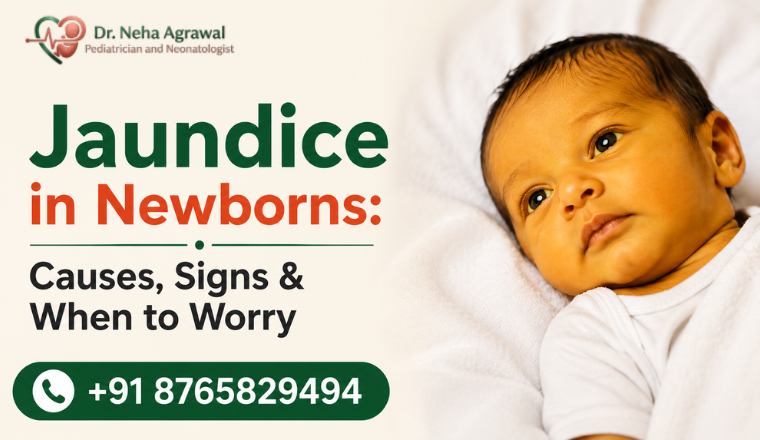
Jaundice in newborns follows a head-to-toe pattern — it typically starts from the face and spreads downward to the chest, abdomen, and legs as bilirubin levels rise.
Common signs include:
- Yellow tinge to the skin, starting from the face
- Yellowing of the whites of the eyes (sclera)
- Yellow coloring of the roof of the mouth
- Dark yellow urine (newborns should have pale/colourless urine)
- Pale or clay-coloured stools
Simple home check: Press gently on your baby's forehead or nose with a finger. If the skin looks yellow when you release pressure, contact your doctor immediately.
When Should You Worry? Red Flag Signs
Most jaundice is mild and manageable. However, seek immediate medical help if you notice any of the following warning signs — especially if you are near a trusted best neonatologist in Noida:
- Jaundice appears within the first 24 hours of birth
- The yellow color spreads rapidly to the arms, legs, and palms
- Baby is extremely sleepy and difficult to wake for feeds
- Baby refuses to feed or has very few wet diapers
- Baby has a high-pitched cry or appears very irritable
- Baby shows arching of the back or abnormal muscle stiffness
- Jaundice persists beyond 2 weeks in full-term babies or 3 weeks in premature babies
These signs may indicate severe hyperbilirubinemia, which can progress to a dangerous condition called kernicterus — a type of brain damage caused by very high bilirubin levels.
How Is Newborn Jaundice Diagnosed?
Doctors diagnose jaundice through:
- Clinical examination — Visual inspection of skin and eyes
- Transcutaneous bilirubinometry (TcB) — A non-invasive skin test using a light meter
- Serum bilirubin test — A blood test measuring exact bilirubin levels
- Blood group testing — To check for incompatibility
- Complete Blood Count (CBC) — To assess red blood cell levels and signs of infection
Treatment Options for Newborn Jaundice
Phototherapy (Light Therapy)
The most common and effective treatment. The baby is placed under special blue-spectrum lights that help break down bilirubin in the skin. It is safe, painless, and highly effective. Depending on bilirubin levels, phototherapy may be done in a hospital or at home with a phototherapy blanket.
Frequent Feeding
Encouraging frequent breastfeeding or formula feeding helps flush bilirubin through the baby's digestive system. Aim for 8–12 feeds per 24 hours.
Exchange Transfusion
Reserved for severe cases where bilirubin levels are dangerously high and phototherapy is insufficient. The baby's blood is gradually replaced with donor blood to rapidly reduce bilirubin levels.
Treating Underlying Causes
If jaundice is caused by infection, blood incompatibility, or metabolic disorders, the underlying condition is treated alongside bilirubin management.
Consulting the best newborn specialist in Noida ensures accurate diagnosis and the most appropriate treatment plan for your baby.
How to Prevent Jaundice in Newborns
While physiological jaundice cannot always be prevented, these steps can reduce severity:
- Feed frequently — Start breastfeeding within 1 hour of birth and feed every 2–3 hours
- Monitor skin color in natural daylight during the first week
- Schedule timely follow-ups — A visit 2–3 days after hospital discharge helps catch rising bilirubin early
- Know your blood type — Blood group incompatibility can be identified during pregnancy
Why Early Consultation Matters
Jaundice is one of the leading causes of readmission of newborns to hospitals in India. Early detection and prompt treatment by an experienced neonatologist can completely prevent long-term complications. Parents in and around Noida and Ghaziabad should not delay consulting a specialist if they notice any yellowing in their baby.
If you are searching for the best neonatologist in Noida to evaluate your newborn's jaundice, ensure your doctor has experience in NICU management and newborn bilirubin assessment.
Frequently Asked Questions (FAQs)
Q1. Is jaundice in newborns dangerous?
Mild jaundice is normal and resolves on its own; severe or untreated jaundice can cause brain damage (kernicterus).
Q2. When does newborn jaundice go away?
Physiological jaundice typically resolves within 1–2 weeks in full-term babies and up to 3 weeks in premature babies.
Q3. Can I treat newborn jaundice at home?
Mild cases may be managed with frequent feeding and sunlight exposure, but always consult a doctor before attempting home treatment.
Q4. Does sunlight help with newborn jaundice?
Indirect morning sunlight can mildly help, but it is not a substitute for medical phototherapy in moderate or severe cases.
Q5. When should I take my jaundiced baby to the best pediatrician in Noida?
If jaundice appears in the first 24 hours, spreads rapidly, or is accompanied by poor feeding, extreme sleepiness, or a high-pitched cry.
Disclaimer: This blog is for informational purposes only and does not substitute professional medical advice. Always consult a qualified pediatrician or neonatologist for your newborn's health concerns.